
 Enodo Insight
- Coordinated fiscal and monetary policy signals expansion
- China to rely more on deficit financing going forward
- Off-balance sheet special bonds to fund Xi's security priorities and alleviate local debt woes
- The Chinese party-state will direct capital to serve its needs
Coordinated fiscal and monetary expansion
Beijing’s plan for a targeted fiscal expansion is taking shape, with announcements this week of a new special treasury bond that is expected to be issued continuously in coming years. This off-balance-sheet financing will allow the central government more sway over the allocation of credit in the service of President Xi Jinping's policy priorities.
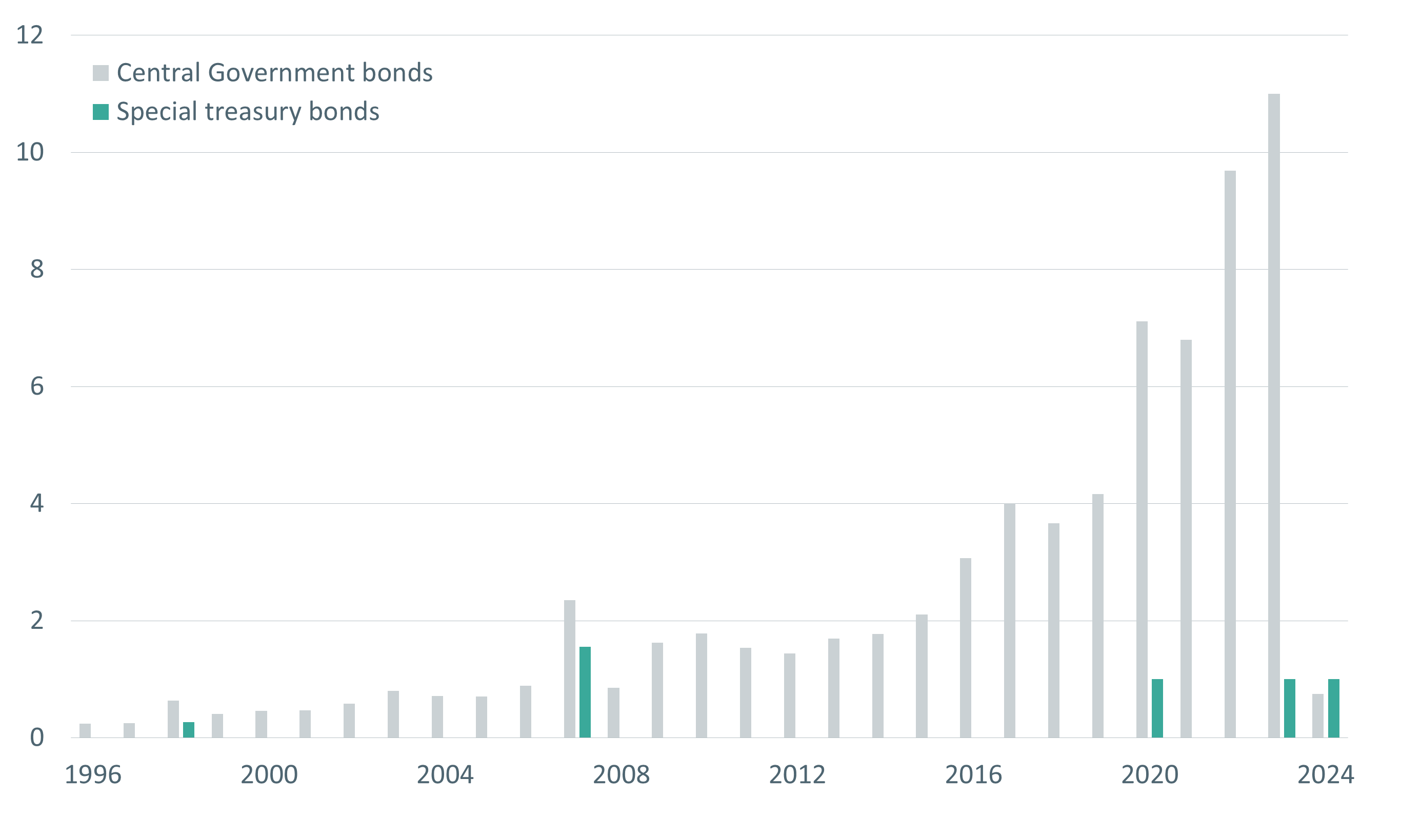

The ultra-long-term special treasury bonds are to be used exclusively for the implementation of major national strategies and the construction of security capabilities in key sectors, Zheng Shanjie, director of China’s state planning agency, said at a press conference during the annual National People’s Congress.
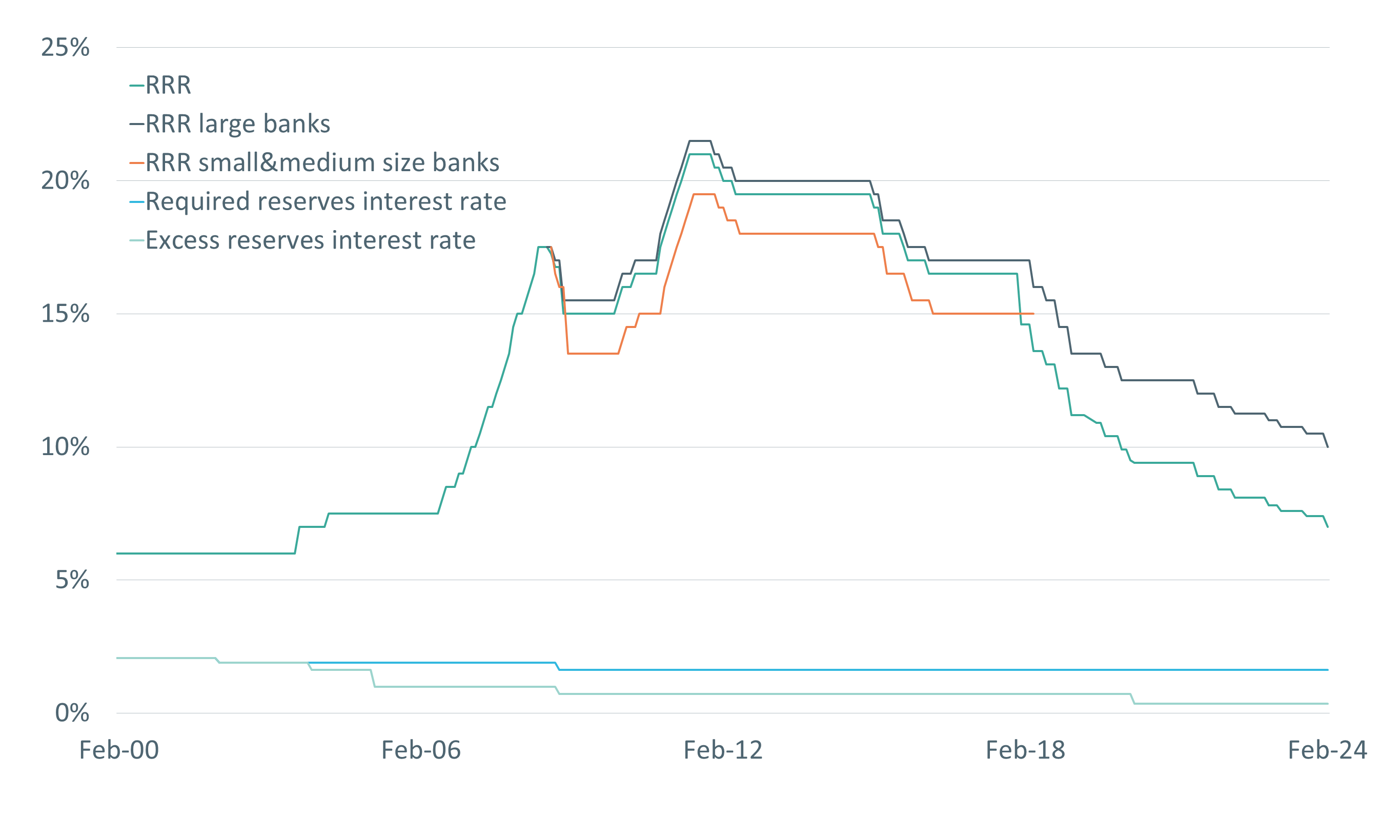
The Central Bank has also stated that China can afford further cuts in the reserve requirement ratio (RRR), basically freeing up liquidity in the banking system. The RRR cut will give banks the ability to ramp up their government bond purchases, as banks are typically the buyers of treasury debt in China, thus boosting monetary growth.
In short, there is a step-shift in the targeted stimulus on the way in China, and combining fiscal and monetary policy action will be expansionary.
However, this capital will not be free to flow towards profitable industries. Instead, the centre will be much more involved in directing credit in pursuit of Xi’s security and “new productive forces” agenda.
Last week, in "'Security' Is The Name Of The Game As China's Policymakers Convene Annual Congress", we explained that “ ‘Security’ is not just tighter control over internal and external threats. It is a comprehensive package – encapsulated in the country’s ‘Holistic National Security Concept’ – that covers financial, economic, and infrastructural security.”
Financing Xi’s China Dream
The special treasury bond is expected to equal Rmb1trn this year and in subsequent years, and will fund Beijing’s pet projects to boost national security. It will be off balance-sheet so does not get counted in the 3% of GDP deficit target announced for this year.
China has only issued new "special treasury bonds" on three occasions before: in 1998, 2007 and 2020. The move underscores the severity of the economic situation, but more importantly, the urgency to implement Xi’s security-led development agenda.
These special treasury bonds, while unusual, are not the only off-balance sheet vehicle the central government is using for allocation to the needs of the state.
There are more special refinancing bonds to come, to the tune of a maximum of Rmb1.5trn, as we discussed in "China Issues New Financing for Old Debts". This will probably be enough to deal with the most dire local government financing vehicles (LGFV) debt problems, but not with China’s overall debt overhang. Clearly, central planners are counting on local belt-tightening in indebted provinces plus renewed growth nationwide to help heal the national debt problem.
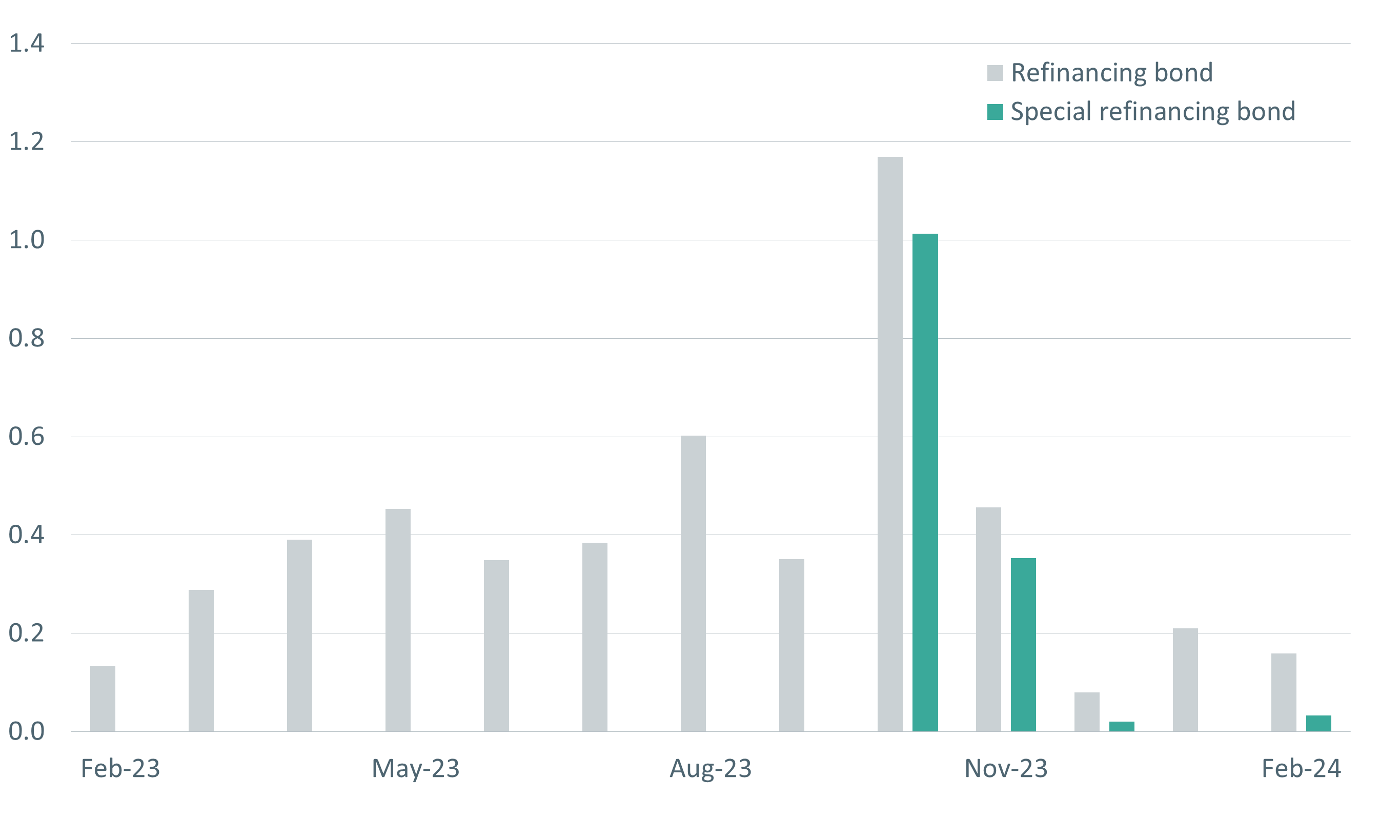
Total off-balance sheet special refinancing bonds plus special treasury bonds are expected to account for 2% of GDP in 2024, a similar level as in 2023 but up from none in 2022. In 2023, local governments sold Rmb1.38trn in special refinancing bonds.
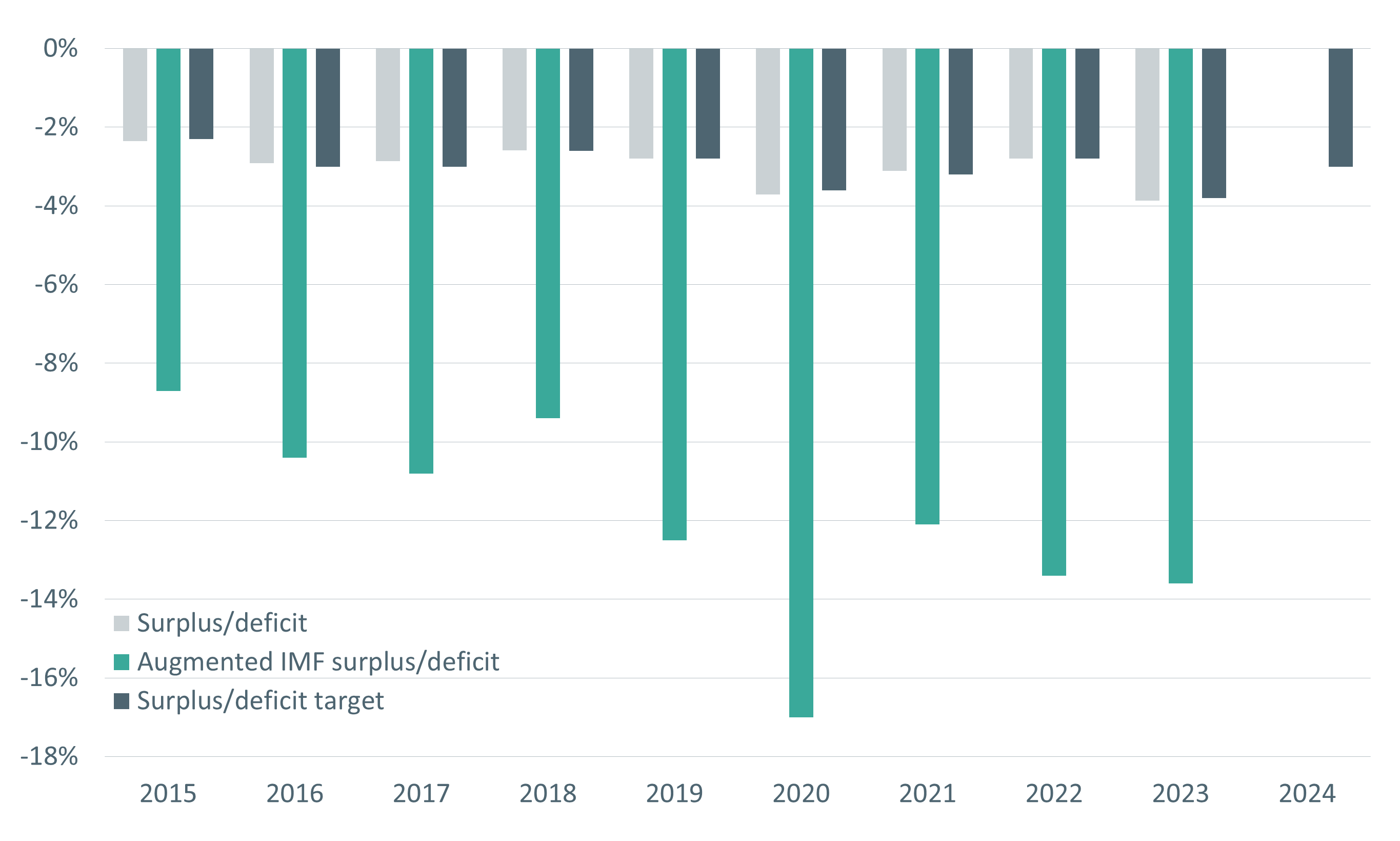
In addition, we judge that Beijing will not be averse to raising its budget deficit target mid-year again.
For 2024, the announced deficit target of 3% of GDP is the same as last year's target revealed at the 2023 NPC. Nonetheless, if last year when Beijing unusually raised the target to 3.8% of GDP is precedent, finance officials have left themselves room for a mid-year increase. They probably think this will be more effective than giving it out all in one go.
This year as was the case last year, Beijing has front-loaded the issuance of Special Purpose Bonds, and marginally increased the amount to be raised in this manner.
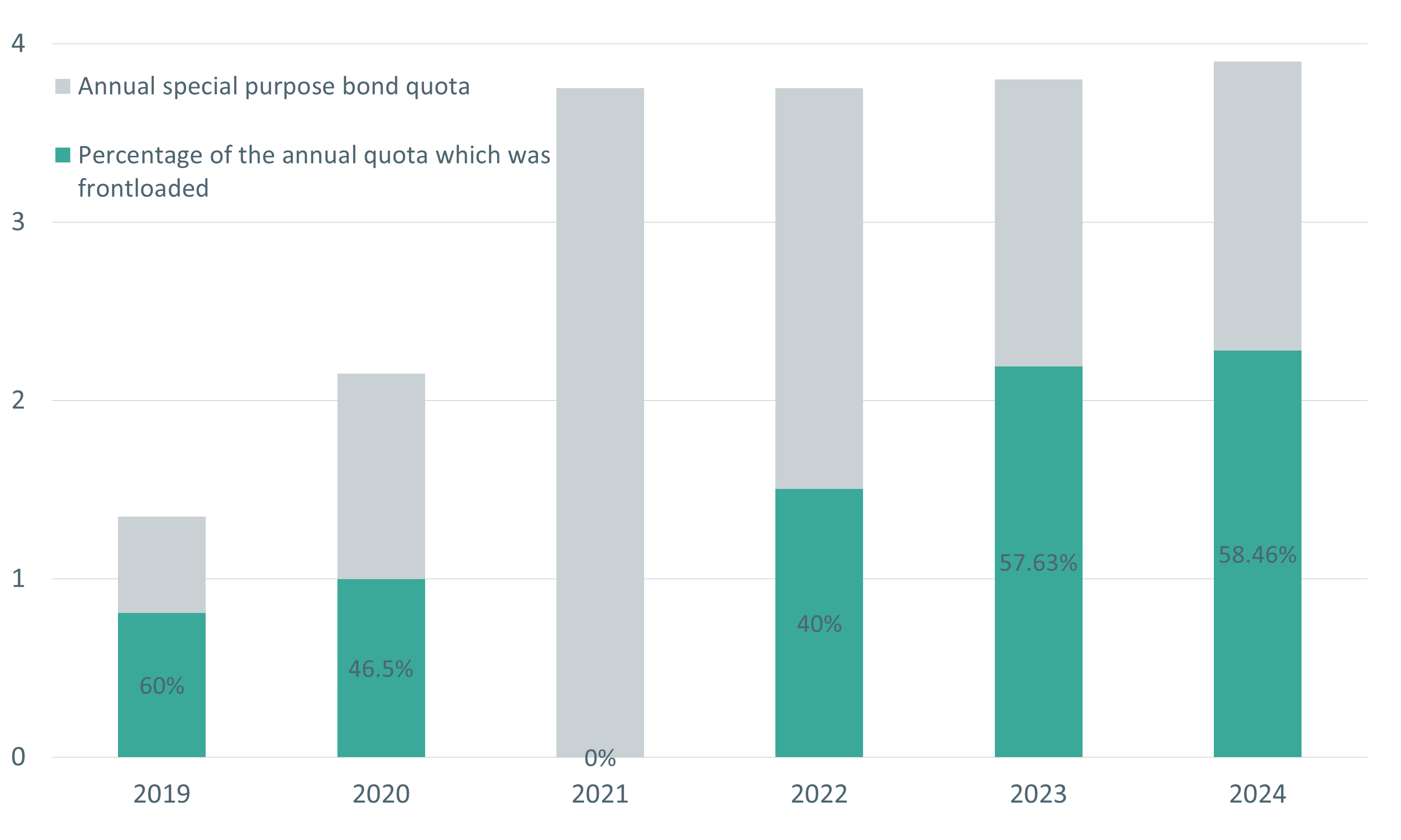
About 60% of the total quota – the maximum allowed – has been issued early in the year, according to the 21st Century Economic News. This funding stream is destined for local governments to avoid a fiscal cliff and help set the pace for fixed investment and shore up local economies at the start of the year.
Finally, hints that the PBoC will cut RRR indicates where the money will come from.
This fiscal stimulus will be expansionary because the banks are expected to buy the bonds as has been traditionally the case. If the bonds are bought by the non-bank domestic sector then there is no boost to overall monetary conditions and the fiscal stimulus peters out quickly.
The PBoC has also announced two more relending tools to support tech innovation and technological renovation, and Chinese media have reported plans to set up a credit market department within the PBoC, highlighting the resurgence of credit policy.
Conclusion
Enodo expects the combined fiscal and monetary policy support to be expansionary, as indicated by an unusual special bonds issuance and by the accommodative tone of the central bank.
Nevertheless, economic policy directions are designed to complement security goals. As long as Xi’s national security agenda drives economic and financial policy, we are unlikely to see a sustained growth pattern.
From now on, growth in China will be sacrificed for ‘security’, however defined.